
V/Octave (1V/Oct)
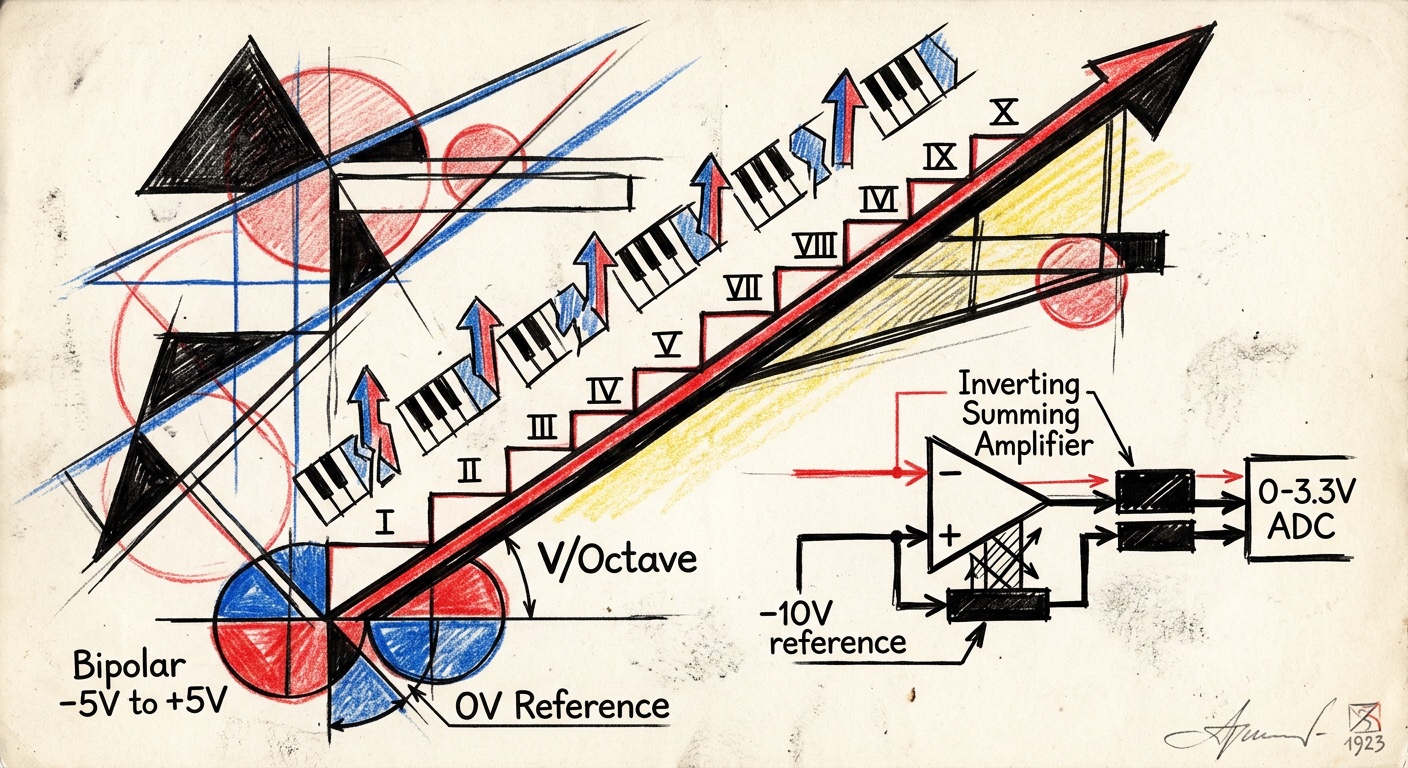
| Property | Value |
|---|---|
| Category | Pitch |
| Voltage Range | -5V..+5V (typ.), up to -3V..+7V or 0..+10V |
| Polarity | Bipolar |
| Bandwidth | DC..~100Hz (portamento, fast sequences) |
| Precision | <1 cent over 5+ octaves targeted |
Description
The V/Octave signal is the Eurorack standard for pitch control. Each volt of voltage change doubles (or halves) the frequency — corresponding to one octave. 1/12 volt equals a semitone, 1/1200 volt equals one cent.
For a usable range of 8–10 octaves, the input stage must map 8–10V of voltage swing at a resolution of <1mV (corresponding to ~1.7 cents).
Use Cases
- Control oscillator pitch (primary use)
- Track filter cutoff frequency (keytracking)
- Set resonator pitch (e.g., Karplus-Strong fundamental frequency)
Eurorack Examples (Mutable Instruments)
- Plaits: V/OCT input, software calibration routine in menu
- Rings: V/OCT for resonator fundamental frequency
- Marbles: Can generate and receive quantized or unquantized V/Oct
Hardware Implementation
Input Stage: Inverting Summing Amplifier
Topology: MCP6004, single supply (V+=3.3V, V-=GND), -10V reference (LM4040DBZ-10, fed from the -12V Eurorack rail via series resistor).
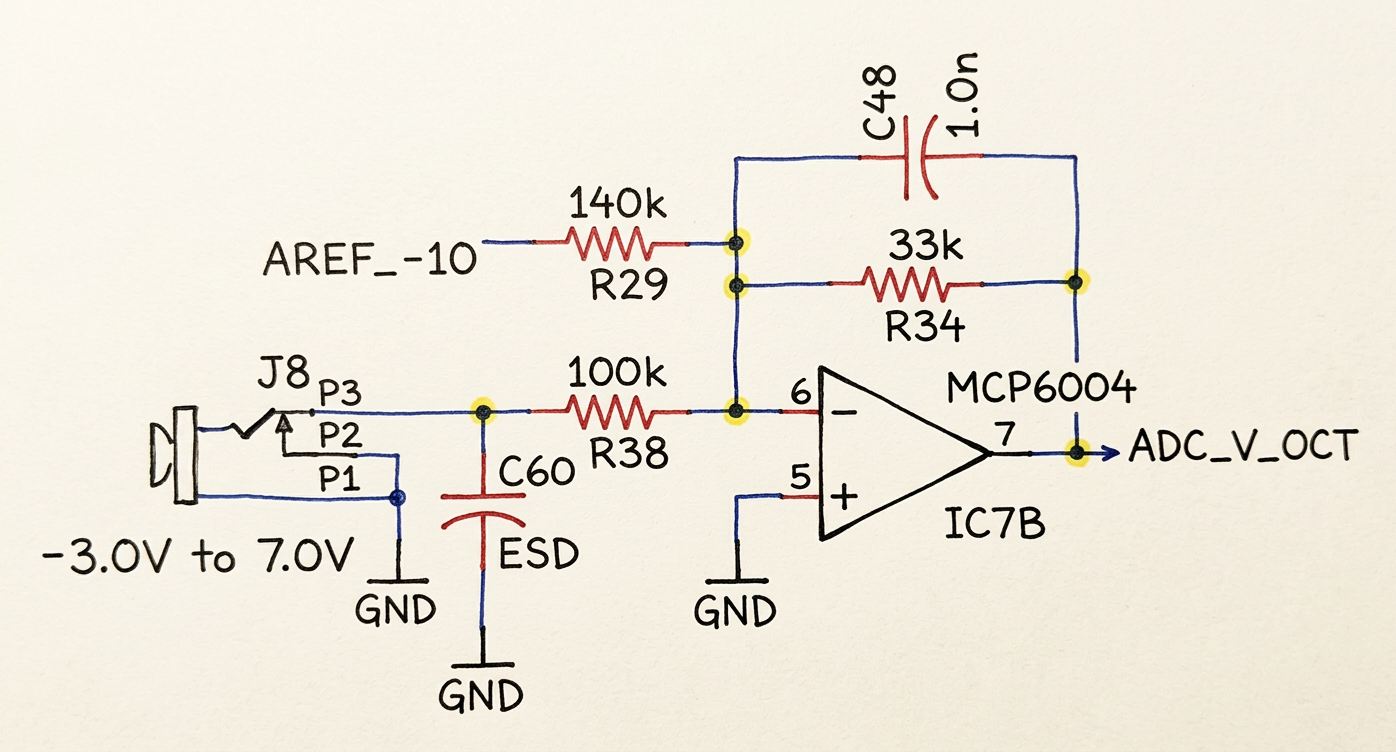
Plaits-specific variant: The schematic above shows the Plaits variant with R_ref = 140k (instead of 200k). This shifts the offset from 1.65V to 2.36V and maps the asymmetric range -3V..+7V — optimized for V/Oct signals that are primarily positive (C1 ≈ 0V upward). The general topology is identical; only the resistor values differ.
Resistor values for -5V..+5V → 3.3V..0V:
| R_in | R_ref | R_fb | V_ref | V_in=-5V→V_out | V_in=0V→V_out | V_in=+5V→V_out |
|---|---|---|---|---|---|---|
| 100k | 200k | 33k | -10V | 3.3V | 1.65V | 0V |
Transfer function: V_out = -(V_in × 33k/100k + (-10V) × 33k/200k) = -(V_in × 0.33 - 1.65)
Signal is inverted (higher input voltage → lower ADC value). Conversion in software.
Precision Requirements
- 0.1% resistors for R_in, R_ref, R_fb (same temperature coefficient, e.g., 25ppm/°C)
- Anti-aliasing: 100–470pF capacitor across R_fb (at 100pF: f_c ≈ 48kHz)
- Voltage reference drift: LM4040DBZ-10 has ±100ppm/°C → at 30°C warming: 30mV drift → 20–30 cents! Consider better reference (≤15ppm/°C)
Calibration (Firmware)
Multi-point calibration (recommended): Two-point calibration (slope + offset) suffices for 3–4 octaves. For >5 octaves, multi-point calibration is superior:
- Feed known voltages (e.g., 1V, 3V, 5V)
- Record ADC values
- Linear interpolation or cubic spline between support points
- Compensates op-amp nonlinearity near the rails and reference errors
ADC Requirements
- Dedicated reference voltage for ADS8866: REF3033 (3.3V) recommended
- Settling time: After mux switching, op-amp output and RC network must be fully settled before ADC conversion
- Oversampling + averaging for noise reduction (e.g., 4× oversampling → +1 bit effective resolution)