
Random and S&H CV
| Property | Value |
|---|---|
| Category | Special |
| Voltage Range | -5V..+5V or 0..+5V |
| Polarity | Uni- or Bipolar |
| Bandwidth | Stepped, variable |
Description
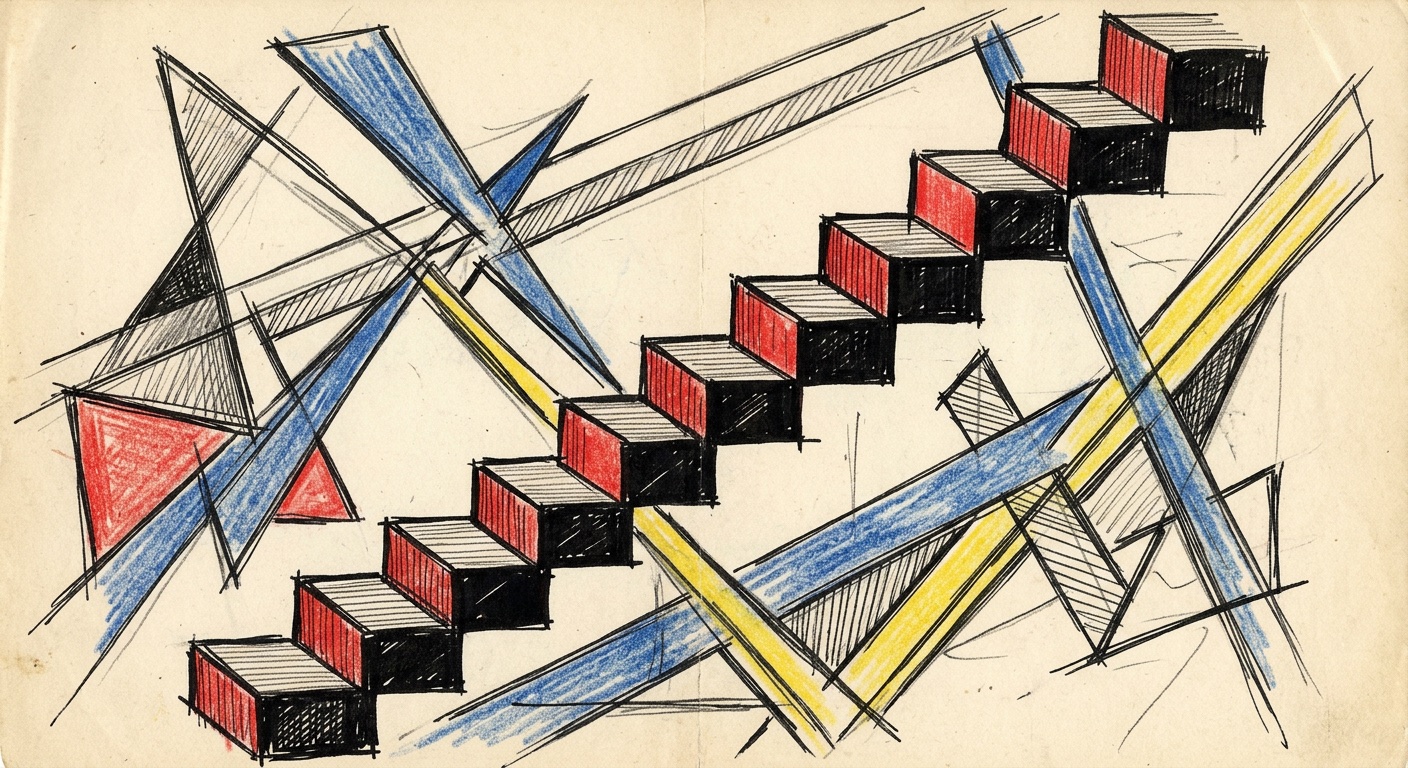
Random CV and sample & hold outputs are signals with random or pseudo-random voltage values that jump to a new value on each clock pulse. The voltage remains constant between jumps (stepped).
Use Cases
- Random melodies (random CV → quantizer → oscillator)
- Random modulation (filter cutoff, parameter variation)
- Generative music (probabilistic sequences)
- Quantizer input (random CV as raw material for scale quantization)
Eurorack Examples (Mutable Instruments)
- Marbles: Generates quantized and unquantized random CV
Hardware Implementation
Standard Input Stage: OpAmp → Mux → ADC
- Bipolar: Standard stage (R_in=100k, R_ref=200k, R_fb=33k)
- Unipolar: Clipping at >5V applies
Firmware Requirements (critical!)
- No linear low-pass filtering (IIR/averaging), as this smears the steps and destroys the rhythmic character. However, a short median filter (e.g., 3 samples) is allowed and recommended. This preserves the steep step edges exactly while eliminating 1-sample spikes (e.g., from mux switching or EMI).
- High sample rate: Mux sample rate must be high enough to not miss the jump moment (stepped signals can be clocked at audio rate)
- Synchronized sampling: If the module has a separate trigger input, sampling should occur synchronized shortly after the trigger (e.g., 1–2ms delay), to give the external S&H module time to settle.
- When used as quantizer input: pass ADC value directly (unsmoothed) to quantization algorithm